



Brad Farrell/Winonan
Sarah Christiaansen/Winonan
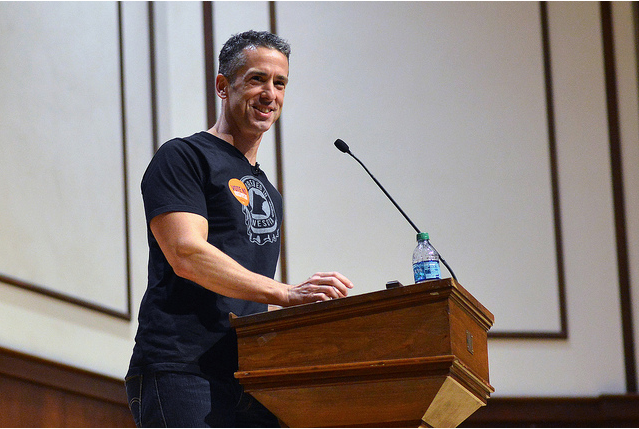
“It gets better,” said activist and YouTube personality, Dan Savage, said Thursday night at Winona State University.
He has said these three words probably thousands of times in the past two years as part of his “It Gets Better” project.
As part of the Winona State University Lyceum Series, Savage spoke to more than 300 students, professors, community members and guests in Somsen Auditorium. Savage and his husband, Terry, created the It Gets Better project in 2010. The purpose of the project is to show lesbian, gay, bisexual, transgender youth that, despite being bullied, tormented or belittled, it does get better.
Savage began with an anecdote about a boy named Billy Lucas. Accused of being gay, Lucas was brutally bullied to the point of ending his own life.
When this happened, Lucas’ parents put up a Facebook page for him to commemorate his death. As Savage browsed the page, one comment struck him.
The username Despicable Me posted: “I wish I had known you, Billy, and been able to tell you that things get better.”
This is where Savage got the inspiration for his project.
“I ached,” Savage said. “I wanted to reach out to that kid. I wanted to tell him that it gets better.”Savage explained when he came out, he was telling his parents not only that he was gay, but also that he would never marry, have children or be a marine. Now, he has been married for 18 years, has an adopted 14-year-old son and could be a marine if he wanted.
“Things have gotten better,” Savage said. “I started to think of other Billy Lucas’ who are still out there and don’t know that it gets better.”
Savage wanted to speak at high schools, to the youth who he knew needed to hear those three words the most. But, he was never invited to a high school.
Looking out the window on a train to the JFK International Airport, a detail that sticks out in Savage’s mind, he had a thought.
“I was waiting for permission to speak to these kids,” Savage said. “I was waiting for permission that the YouTube/Twitter era didn’t care about.”
Savage immediately called his husband, who he said is a private person, and asked if he would do this project with him. To Savage’s surprise, Terry said yes. That night, they filmed the first It Gets Better video and uploaded it to YouTube.
The duo wanted 100 videos to be made. The first indication that far more than this would be made came before even the second video.
After thousands of emails and two computer crashes, 600 videos were posted in the first five days from people all over the world. Today, the project has more than 70,000 videos and many subsequent projects all over the world.
“Our goal wasn’t to have the biggest YouTube channel ever,” Savage said. “Our goal was to save lives.”
Savage said that the lives that were saved were not just because of Terry and himself, but everyone that made a video.
Anyone who uploaded a video unwittingly volunteered to counsel, he said.
Even if the project had only received 10 videos and only saved one life, Savage said he would still consider it a success.
“The fact that there are 70,000 videos and we have saved countless lives shows the fundamental decency of humanity,” Savage said.
From the get-go, Savage said the point of It Gets Better was to be the parents of lesbian, gay, bisexual, transgender youth.
He ended the presentation with a story about a 15-year-old lesbian.
This girl wrote to Savage saying she had been watching the videos and they were giving her hope because she could see women that had gone through what she went through.
When this girl came out as a lesbian to her parents, instead of accepting her, they made her get therapy. The girl said that she gets up everyday and looks at her parents, who were being so horrible and unhelpful, and loves them. She loves them not for who they are now, but for who they will be in 10 years.
“We’re going to talk to your kids whether you realize you want us to or not,” Savage said. He looks forward to getting a letter from the girl’s parents saying thank you for loving her when they did not.
For more information on the It Gets Better project, visit www.itgetsbetter.org
Contact Sarah at [email protected]