



Contributed Photo
Oksana Carlier/Winonan
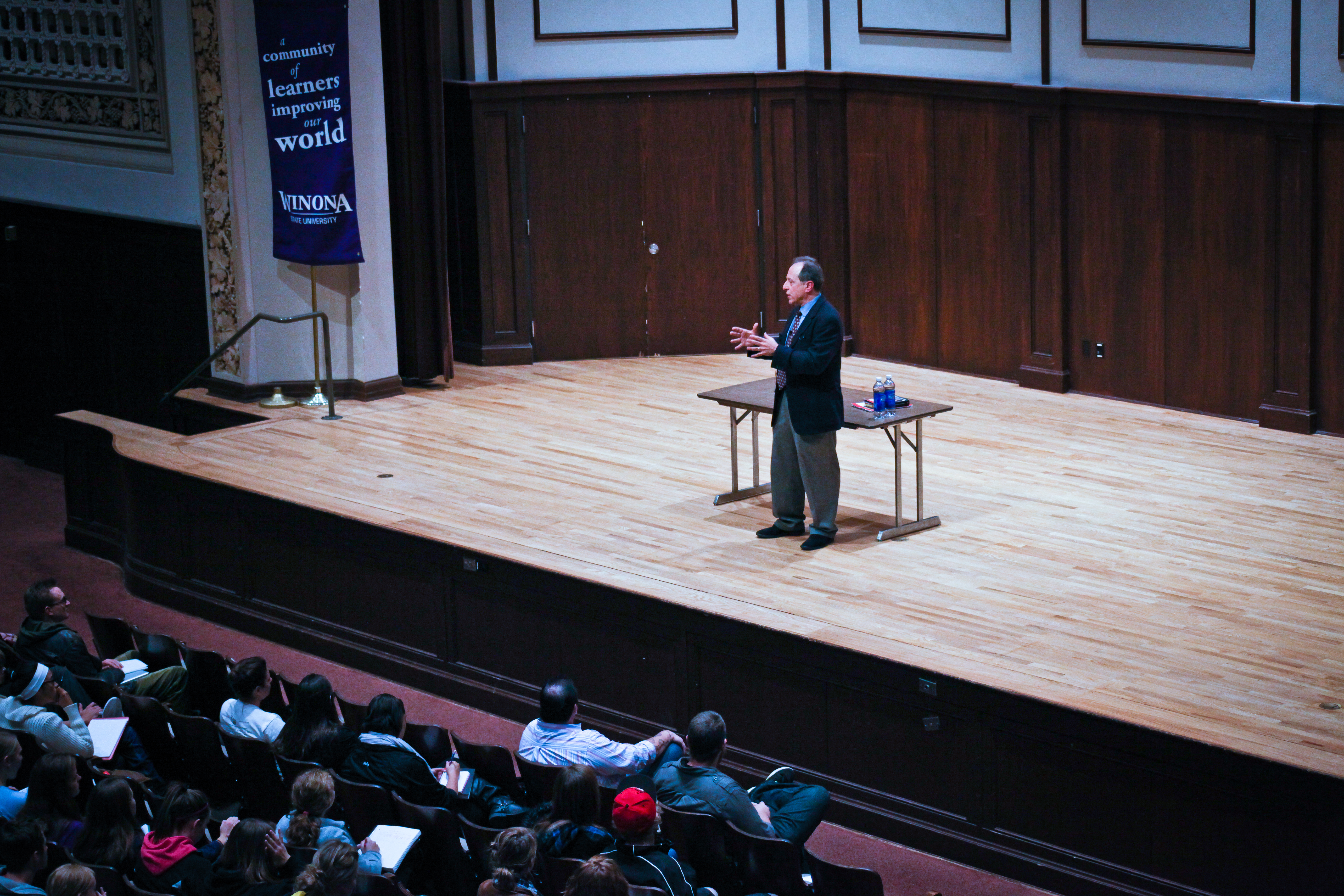
The boy crisis in America today is caused by violence and rooted in the origins of masculinity, said the author of “Guyland” during his presentation at Winona State University last Tuesday.
“Boy crisis” is “Guyland” author Michael Kimmel’s term for the conflicting expectations society has for adolescent men.
There was previous boy crisis at the end of the 19th century and into the 20th century, Kimmel said. He explained that it was a sort of boys liberation movement.
Sports went professional, there was a push for male teachers, the idea of a male hangout place was created, people began to look at Jesus’ manly side and in 1910, the Boy Scouts of America came into existence.
Kimmel looked back to historical examples in his research of young men today.
“Rather than blame the guys, what I wanted to do was I wanted to see what kind of pressures they were under from other guys,” Kimmel said.
Kimmel explained that he thought violence was a cause of the “boy crisis.” Kimmel went on to talk about the 30 school shootings since 1992.
The power point presentation Kimmel showed said that, “all [shooters] were white, rural or suburban, boys, using rifles or assault weapons—and all were bullied and gay-baited.”
Kimmel also characterized the schools with shootings, saying that they all shared three common characteristics. Each of the schools has a lack of diversity, was predominantly evangelical and, most importantly, were “jockocracies.”
“Jockocracies,” Kimmel said, are places where the boys in football and basketball run the school.
Kimmel blamed guns for these shootings, saying that other countries do not have these shootings because they have stricter gun laws.
Kimmel discounted the idea that ‘people do not kill people, guns kill people;’ according to Kimmel, it takes both people and guns to kill someone.
Before he listed his explanation of the reasons behind the boy crisis, Kimmel went through various other explanations, rejecting each as he went along.
Feminism, he said, was not the root cause of the crisis, nor was the gender achievement gap.
At the end of his presentation, Kimmel reiterated the end of his book, saying that resilience and learning from the past is the way to go.
Kimmel also said boys should have an adult in whom they can trust, along with good male and female friends.
Rafael Narvaez, a sociology professor, said, “I think the most important part of any book like this is, what do we do about this?”
Kimmel said acknowledging the boy crisis and its ideological roots is crucial to resolving issues adolescent men face.
Jennifer Chernega, another sociology professor at Winona State who uses the book in her courses, said Kimmel has opened up a new field of masculinity studies. “His ideas of masculinity are groundbreaking,” she said.
Chernega said the student responses to the book’s points have been mixed, with some students agreeing that the book exemplifies Winona, while others disagree.
Chernega said she thinks that she sees this boy crisis happening in parts of Winona. “I think students have a right to be angry about this kind of culture in their environment.”
Narvaez said, “He paints a very vivid picture of boys in trouble and that is really what makes the book. The book holds a mirror to the guys and forces them to reflect.”
Contact Oksana at [email protected]