



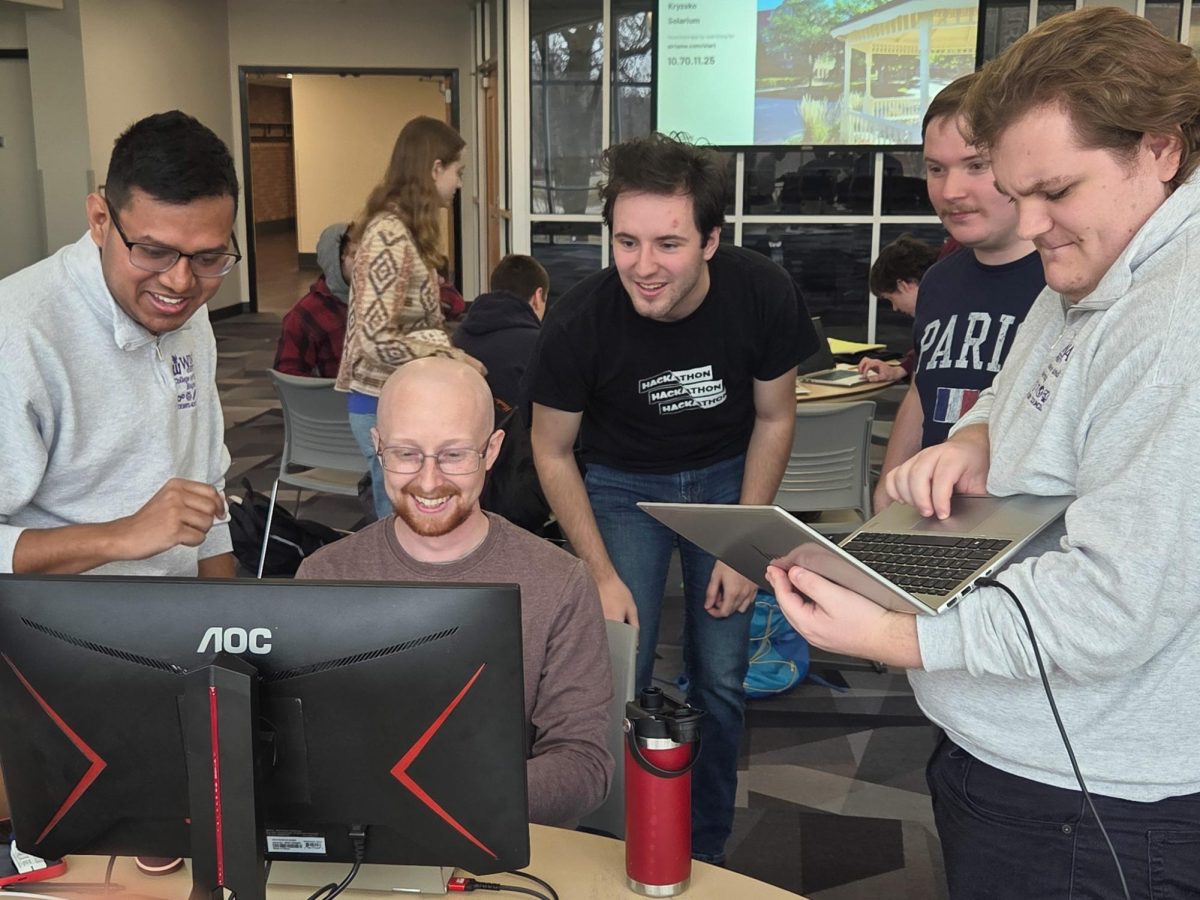
Everyone settled in for a long day, one full of excitement, app creation and overall loads of creativity. On Feb. 28. For the second year in a row, Winona State University’s computer science club and the women in computing and STEM (WICS) club held a six hour long hackathon.
A hackathon is typically a 24-hour event where teams or individuals are tasked with creating an app or project within a set theme. These themes often range from artificial intelligence, website design or accomplishing a specific goal for a company.
The day began at 8:30 a.m. with a complimentary breakfast. Once participants were fueled up, groups were formed and the work began. Teams had four themes to choose from for their project: artificial intelligence and me, digital resistance, ecosystems of the web and data poisoning.
Along with the four themes, teams were given a rubric regardless of the theme they chose. They would be judged on their creativity, if they solved the intended problem, the relevance of their project and finally if their project had purpose behind it.
Hamilton Ferris, a fourth-year majoring in computer science and the current president of the computer science club, enjoys seeing people think outside the box on their projects.
“Computer science students especially but more broadly STEM students, don’t really get that chance to build something creatively. Which is fine, it’s the scope of the degree but this outlet is really nice for people,” Ferris said.
As the day progressed, participants could often be found mingling with other groups. Checking in, seeing what they were working on and laughing throughout the long day. While it was a competition, everyone was excited to see the finished products.
“What I really enjoy is that it’s collaborative and also competitive and you just get to see what everyone’s accomplished. It’s so much fun to see, and like ‘wow I can’t believe they did that in six hours,’” Ferris said.
At 3:00 p.m., as the event concluded, teams needed to present their project to the fellow teams and the panel of judges. Shimin Lin, a professor in the computer science department, often sees many of these students in a more structured classroom environment. By being a judge for the competition, he got to see them in a different light.
“They already make good projects but getting to have creative ideas and doing something hands on is really great. This is a great event for filling their programming skills and allows them to solve real world problems,” Lin said.
The group that earned second place included Ritesh Shah and Braden Gjervik. These two students picked the theme digital resistance to focus their project on. Specifically, they focused on data safety and protecting the data that is collected when someone takes a picture.
When taking a picture the location it was taken, the type of device it was taken on and much more is recorded. When that images is posted somewhere, that data becomes available to anyone that wants it. They created a web extension to remove this sensitive data from an image without affecting the image quality. The two students each took $40 for their work.
The team that took first place included Pronob Kumar, Trevor Michel, Walter Weber and Ian McKinzie. Their group primarily focused on data poisoning. They wanted to make machine learning models that could predict certain parameters and then poison the data and see how it responded.
Their group took several data sets such as information on supreme court justices, medal counts from the Olympics and heart disease data to train models to predict different variables. The supreme court justice data was trained to predict the age at which they would pass away. They took into account current age, political party, etc. The Olympics medal data listed athletes, their home country and how many medals they won.
Most participants were computer science or data science majors but Ian McKinzie, a fourth-year majoring in geoscience, got roped along by his roommate.
“I know just enough about coding to actually write something but barely anything else so I figured that makes me the perfect guy to go in and screw things up,” McKinzie said.
They poisoned both of these data sets with incorrect numbers and dates to see how their model would respond. They also used data from a heart disease set to create an app to predict someone’s chance of developing a heart disease. Their work earned them first place and they each took home $50.
The computer science club and WICS hope to make the hackathon an annual thing, encouraging students to think outside the box and let their creativity slow. Regardless of the themes and how they may change, participants are sure to come up with innovative solutions.